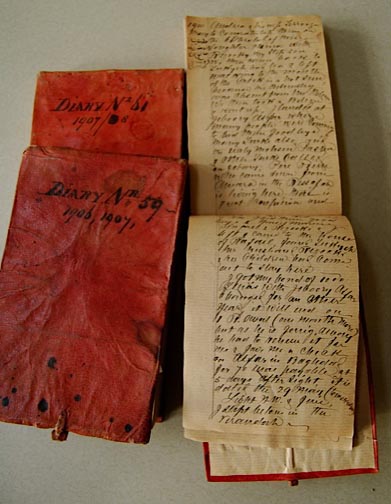
Joseph Mathia Svoboda began writing personal diaries around 1862. As part of the Lynch Brothers’ Euphrates and Tigris Steam Navigation Company, Svoboda made constant journeys back and forth from Baghdad to Basra and documented details from these trips in his diaries. Most entries focused on steamer trips and described the weather and wind, recorded cargo and passengers, and mentioned different locations along his journeys. For example, some entries describe epidemics spread by steamer traffic, and how these illnesses were brought under control by the authorities. In 1897, his son Alexander Richard Svoboda began keeping a travel journal, documenting a trip through the Middle East into Europe over the course of three and a half months.
In 1929, Alexander Svoboda left his father’s diaries with an unnamed Catholic priest, who turned them over to Ya’qub Sarkis (1876-1958), a historian from Baghdad. Sarkis took notes in Arabic on the margins of the diaries as part of his research on Iraq. He kept the diaries in his private library and later transferred them to Baghdad College, which was later renamed Al-Hikma University. After the university was nationalized during the Saddam Hussein regime, some of the diaries in the Sarkis library were moved to the Iraqi National Museum of Antiquities and the National Manuscript Center.
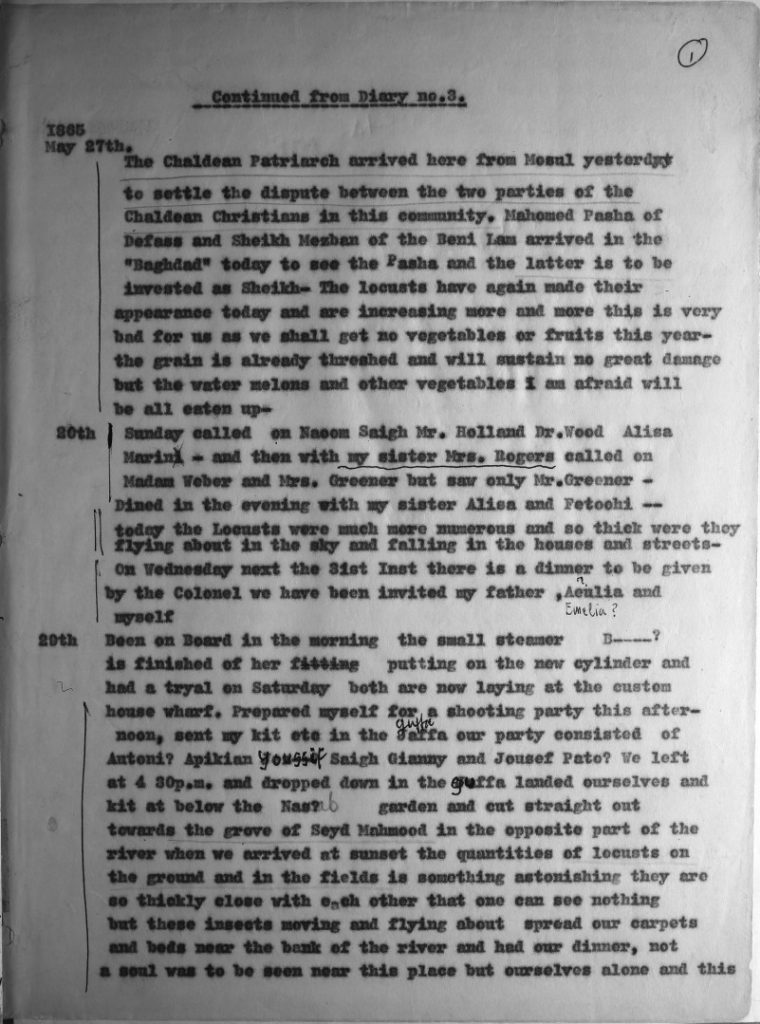
In the 1970s, Al-Hikma University scholar Margaret Makiya borrowed and began transcribing the Svoboda diaries. In 1985, Svoboda family descendant Professor Henry Svoboda, then head of Iraq’s National Centre for Engineering and Architectural Consultancy, began writing a family history with architect Nowf Allawi using Makiya’s transcriptions.
Following the United States’ invasion of Iraq, research in Baghdad became increasingly difficult. After the death of Professor Henry Svoboda in 2006, Allawi contacted Professor Walter G. Andrews and the Ottoman Texts Archive Project (OTAP) at the University of Washington for assistance in continuing this project. The Svoboda Diaries Project was born to take on the task of digitizing both Makiya’s transcriptions and the remaining original diaries.
Today, the Svoboda Diaries Project continues to flourish, growing from the work of one faculty member, a staff consultant, and a few interns to a large project including many undergraduate interns from different fields of study, and a few graduate students and consultants. The project has produced a translation of the travel journal of Alexander Richard Svoboda as a bilingual digital edition, and transcriptions of six of Joseph Svoboda’s diaries, all of which are available through the Diary Viewer.
The Svoboda Diaries Project continues to produce diary transcriptions and improve the accessibility of these digitized materials so they can be used as tools for research.