This website presents selected diaries by Joseph Svoboda and a travel journal by his son, Alexander Svoboda. The Svoboda family lived in Baghdad from the early nineteenth century until the late twentieth centuries, part of a small but vibrant European community in cosmopolitan Ottoman Baghdad. The diaries document the life of Joseph through detailed daily entries spanning over 40 years, from 1862 to his death in 1908, offering a day-to-day view of life at the confluence of European and Ottoman worlds during the last decades of the Ottoman Empire. The travel journal by Alexander documents his 1897 journey from Baghdad to Paris.
The Joseph Mathia Svoboda Diaries
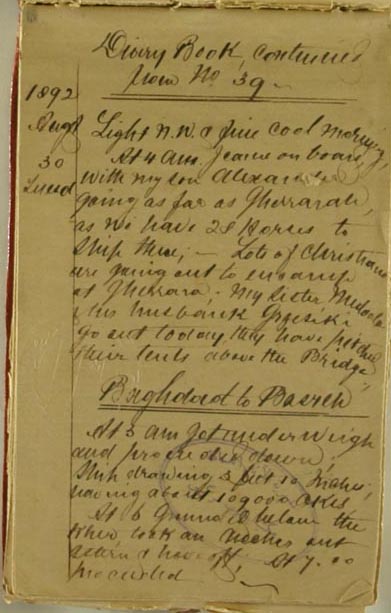
The Joseph Mathia Svoboda diaries capture over 40 years of trade on the Tigris, and the life, politics, and landscape of Ottoman Iraq through the perspective of a British steamship purser with a rich family history and local connections. Unfortunately, not all of Joseph’s diaries have survived. The UW Libraries provides access to scanned versions of 19 of 61 of the original diaries, and transcriptions of 32 diaries by Margaret Makiya.
Additionally, six diaries have been transcribed by the Svoboda Diaries Project and are available interactively via our Diary Viewer.
To download the transcriptions or summaries of the diaries, click here.
The Alexander Svoboda Travel Journal
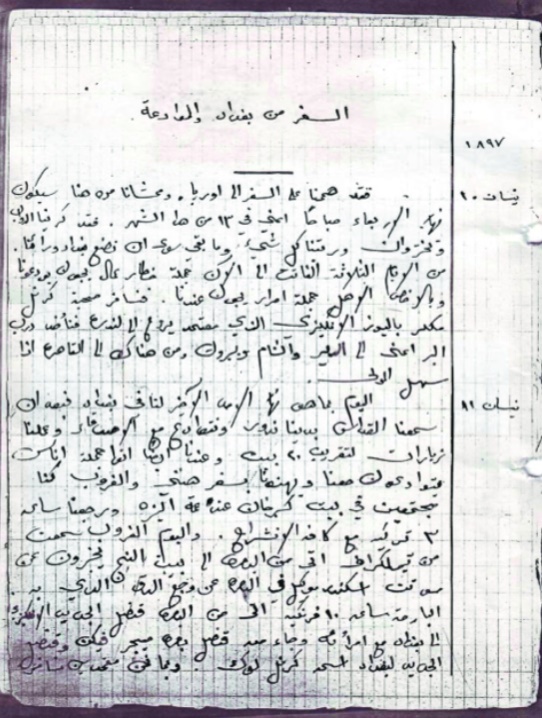
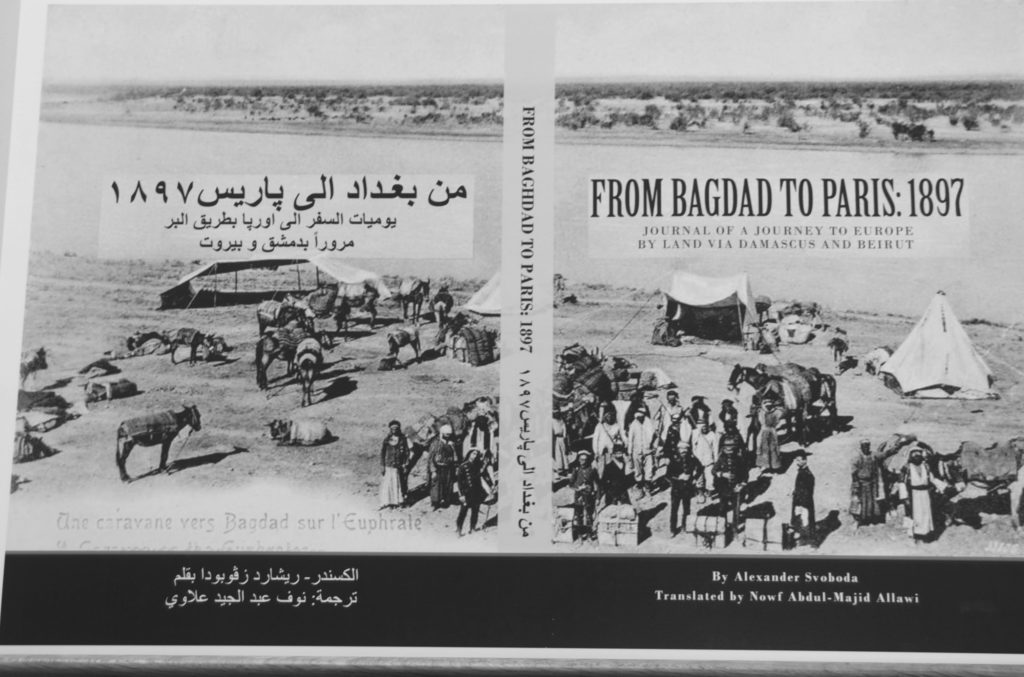
Written by Joseph’s son, Alexander Richard Svoboda, the travel journal details Alexander’s journey from Baghdad across the Middle East to Cairo and thence to Paris in the spring and summer of 1897. It consists of 65 pages and was first published on-line in 2011, with a transcription and translation. In 2013, the travel journal became available as a dual language print-on-demand hard copy book titled From Baghdad to Paris: 1897.
To view the travel journal online, click here.
The Return Journal
Alexander began a journal in English on his return journey to Baghdad with his French wife Marie Josephine Derisbourg, but abandoned the effort after writing 14 pages that spanned only a few days. Titled “Journey to Baghdad from Europe Via Der-el-Zor and Mosul Oct. 1900”, it is not available.
Joseph Svoboda
Joseph Mathia Svoboda (17 October 1840 – 19 January 1908) was born in Baghdad to Anton Svoboda and Euphemie Joseph Muradjian. As a young man, Joseph lived for a number of years in India, particularly in Bombay, with his brother, Alexander Sandor Svoboda (1826-1896). In 1858, Alexander settled in Smyrna (now Izmir), and opened a photography studio.1
Meanwhile, Joseph returned to Baghdad in 1857 and began work one year later for the Euphrates and Tigris Steam Navigation Company, an arm of the British-owned Lynch Brothers Trading Company. As an officer on board the company’s steamers, Joseph made regular trips up and down the Tigris, carrying cargo and passengers to different ports along the river from Baghdad to Basra. During this time, he began keeping personal diaries in English. Joseph kept 61 volumes of diaries until his death in 1908, detailing his personal life and experiences on the river, as well as social and political events that he witnessed2
Anton Svoboda and Euphemie Muradjian
Anton Svoboda and Euphemie Joseph Muradjian were the first members of the Svoboda family to live in Baghdad. Born in Osijek in modern-day Croatia in 1796, Anton was a citizen of the Austro-Hungarian Empire who journeyed from Vienna to Baghdad by way of Istanbul. He established himself as a glass merchant, importing glass and crystal from Bohemia to Baghdad.3 Euphemie was from a prominent Chaldean-Catholic Armenian merchant family in Istanbul. She may have been related to the Mouradgea d’Ohssons of Istanbul, the family of Ottoman-Armenian diplomats and historians.4 Anton and Euphemie married in Baghdad on 12 February 1825 and had eleven children.5 They survived the many floods and plagues that haunted the city in the second half of the 19th century as well as the revolution that overthrew the Mamluk regime in Baghdad in 1831 by cloistering inside their home for months while social and political turmoil ravaged the rest of the province.6 The Svobodas lived in the Christian quarter of Baghdad and formed part of a small, but closely bound, community of Ottoman and European Christians.7 Anton served as a representative for Austro-Hungarian political interests in Baghdad. He also maintained a large estate in Baghdad, which served as a frequent stopping point for European travelers passing through.8
Alexander Svoboda
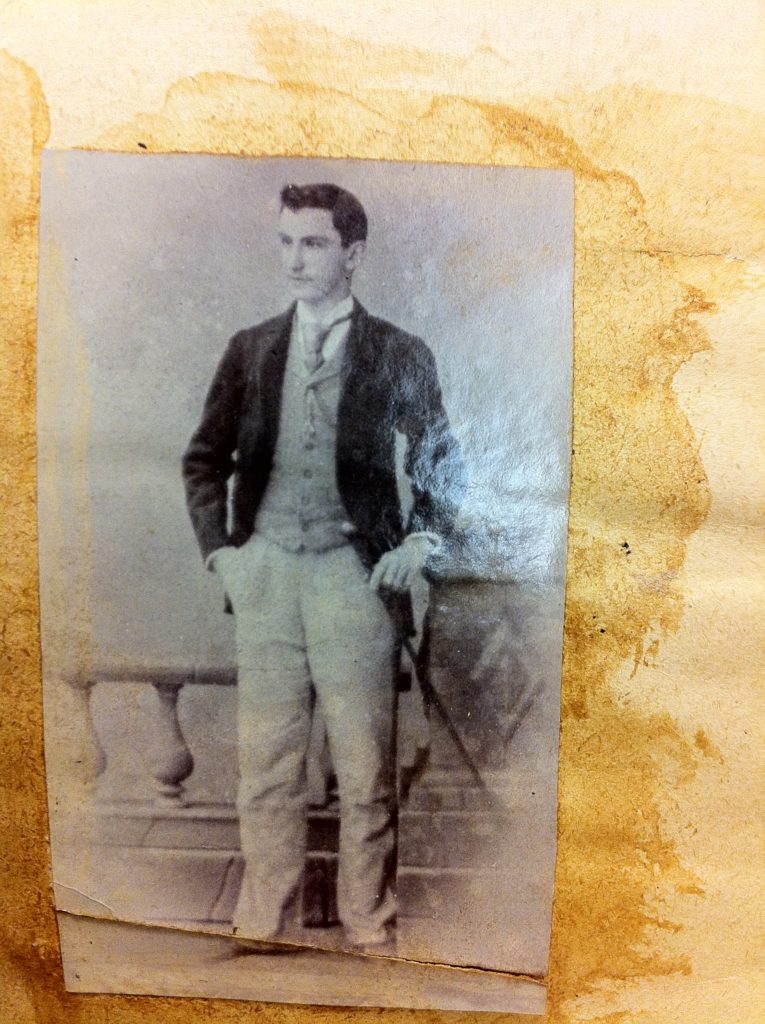
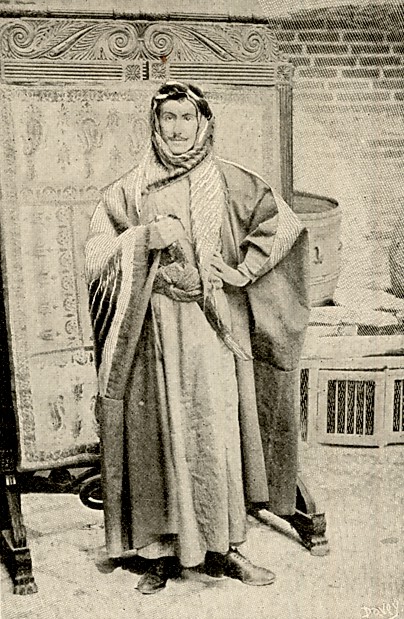
Alexander Richard Svoboda (7 July 1878 – 1946) was born in Baghdad to Joseph Mathia Svoboda and Eliza Marine Svoboda. In 1897, at the age of nineteen, he journeyed across the Middle East and Europe in the company of his parents, as well as the outgoing British Consul Colonel Edward Mockler and his retinue. They followed a circuitous route from Baghdad to Cairo and then to Paris over a three and a half month journey. Alexander kept a day-by-day account of this journey in Iraqi Arabic, known today as the Alexander Travel Journal. He stayed in Europe for three years, during which time he married a French woman named Marie Josephine Derisbourg.
His father Joseph opposed Alexander’s marriage to Marie, and the marriage itself did not prove to be a happy one. Marie later divorced him and returned to France. Alexander collected stamps and tried to make a living by producing postcards but had little success. In 1929, Alexander left Baghdad for Istanbul, where he remarried and died. We currently know very little of the details of his life other than his European journey, though we may learn more as we study the diary of his father Joseph.

z
- Makiya, “The Svoboda Diaries,” 63; Michèle Hannoosh, "The Art of Wandering: Alexander Svoboda and Photography in the Nineteenth Century Mediterranean," The Mobility of People and Things in the Early Modern Mediterranean ed. Elisabeth A. Fraser (New York: Routledge, 2020), 131-151.
- For more details on Joseph’s diaries and life, see Makiya, “The Svoboda Diaries.”
- Margaret Makiya, “The Svoboda Diaries,” Baghdad College of Arts Journal 64 (1969): 37–67. Anton’s official nationality and ethnic background seem to have been difficult to classify. At various times, he is described by others as German, Hungarian, or Austrian. See Robert Cotton Money, Journal of a Tour in Persia, During the Years 1824 & 1825 (London: Teape and Son, 1828), 234; Anthony Norris Groves, Journal of a Residence at Bagdad: During the Years 1830 and 1831 (London: J. Nisbet, 1832), 176; Ida Pfeiffer, A Woman’s Journey Round the World, from Vienna to Brazil, Chili, Tahiti, China, Hindostan, Persia, and Asia Minor. An Unabridged Translation from the German of Ida Pfeiffer, 4th ed. (London: Nathaniel Cooke, 1854), 250; W. H. Colvill, “Sanitary Report on Turkish Arabia,” Transactions of the Medical and Physical Society of Bombay, no. 11, 2nd Series (1871): 49.
- Money, Journal of a Tour in Persia, 234–6. A brief obituary for Anton Svoboda mentions that he was an avid excavator and numismatist, who “married the daughter of Baron Mouradgea d’Ohsson, niece of Baron d’Ohsson, the great writer on Turkish institutions,” presumably referring to Ignatius Mouradgea d’Ohsson and his Tableau Général de l’Empire othoman. “Literary Gossip,” The Athenaeum, 10 May 1879, 604. There is no corroborating evidence of this genealogy for Euphemie Muradjian.
- Makiya, “The Svoboda Diaries,” 39.
- Makiya, “The Svoboda Diaries,” 39; Pfeiffer, A Woman’s Journey Round the World, 250; Colvill, “Sanitary Report on Turkish Arabia,” 49.
- Various travelogues make consistent reference to the small size of the community of European expatriates in Baghdad. See for example Frederick Charles Webb, Up the Tigris to Bagdad (London: E & F. N. Spon, 1870), 34.
- Groves, Journal of a Residence at Bagdad, 176; Money, Journal of a Tour in Persia, 234–6; Pfeiffer, A Woman’s Journey Round the World, 250–9.